
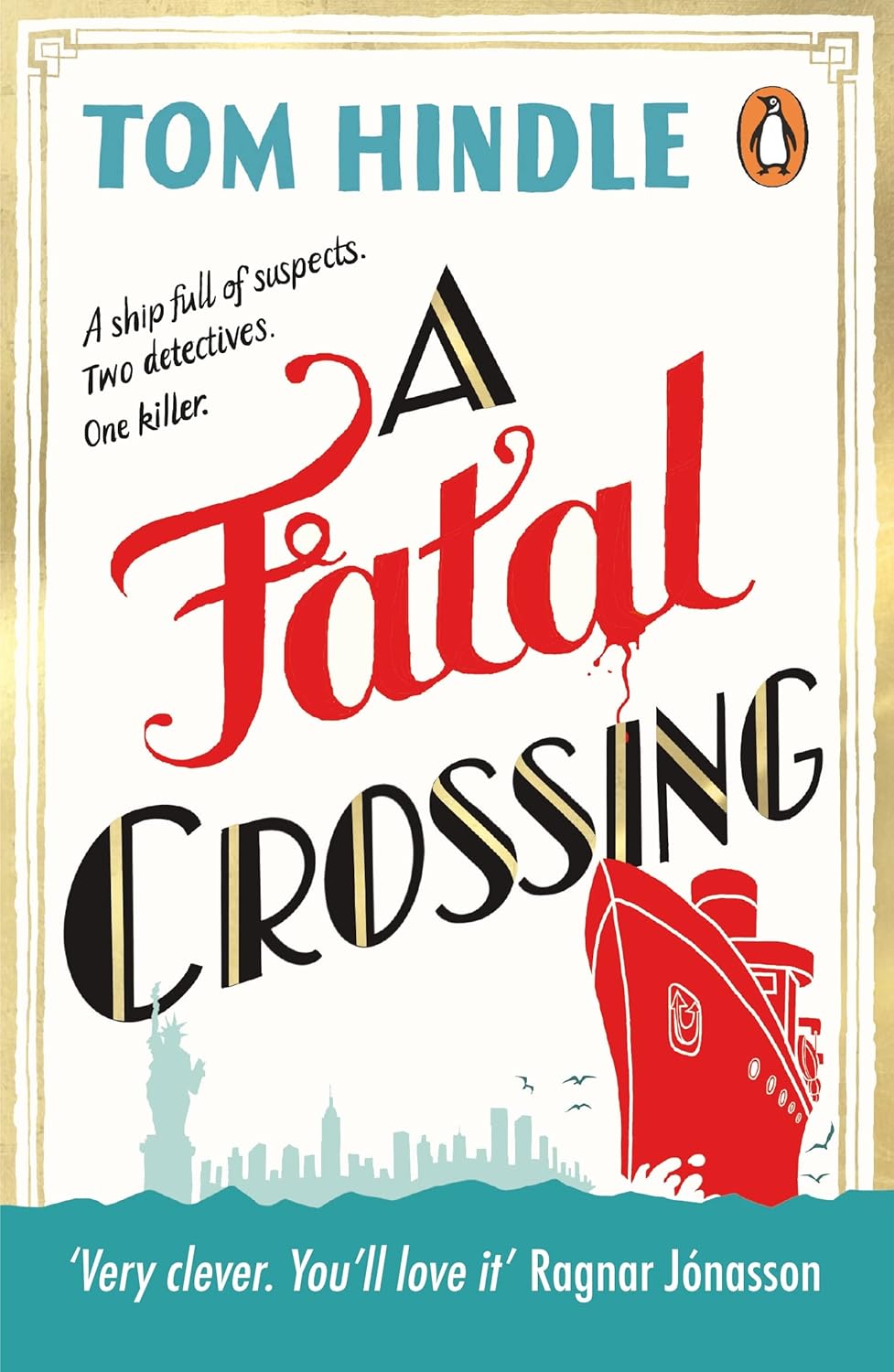
Official Blurb
A Fatal Crossing by Tom Hindle | Goodreads
November 1924. The Endeavour sets sail from Southampton carrying 2,000 passengers and crew on a week-long voyage to New York.
When an elderly gentleman is found dead at the foot of a staircase, ship’s officer Timothy Birch is ready to declare it a tragic accident. But James Temple, a strong-minded Scotland Yard inspector, is certain there is more to this misfortune than meets the eye.
Birch agrees to investigate, and the trail quickly leads to the theft of a priceless painting. Its very existence is known only to its owner . . . and the dead man.
With just days remaining until they reach New York, and even Temple’s purpose on board the Endeavour proving increasingly suspicious, Birch’s search for the culprit is fraught with danger.
And all the while, the passengers continue to roam the ship with a killer in their midst . . .
Summary
A Fatal Crossing is not a conventional closed-circle mystery. Rather, it unfolds as an inquiry into a tangled web of bittersweet relationships among the ship’s passengers. The investigation begins with the theft of an apparently invaluable painting, but much of the novel is spent pursuing false leads and red herrings that give only the illusion of progress. Eventually, the truth surfaces, accompanied by a twist of considerable ingenuity—though one that can be partially anticipated. The conclusion leaves several questions unanswered and hinges on legal ambiguities that may test the reader’s willingness to suspend disbelief.
Impressions
Initially, I was drawn in by the maritime setting and the presence of an irritable detective—an appealing combination I hadn’t encountered before. However, as the novel progressed, I realised it was not what I had hoped for.
My chief criticism is the under-utilization of the naval setting. The Endeavour could just as easily have been an office building under lockdown. The ship offers little by way of atmosphere or narrative depth, and it feels as though the author confined the story in order to present a “technically unique” premise. In sustaining reader interest, he resorts to a drip-feed of largely circumstantial and insubstantial leads. When all narrative tricks are exhausted, the central twist is unveiled, casting an illusion of complexity. Unfortunately, this moment lacks conviction due to inconsistencies in the protagonist’s characterization.
The protagonist, Timothy Birch, is by far the most naïve and unengaging character in the book. Quite often his actions do not align with his emotions, and any substantial character development arrives only at the very end—too late to be meaningful. The author attempts repeatedly to justify Birch’s selfishness, but only succeeds in increasing its intensity rather than explaining its origins. His supposed love for Amelia feels underdeveloped and unearned. The novel ends with Birch portraying himself as a self-appointed saviour, justifying morally questionable actions in a way that renders him, in my view, a rather pitiable and ethically hollow figure. Harsh though this may seem, I suspect many readers who reach the end will share this sentiment.
Strengths
The book’s main redeeming feature is the ingenuity of the central crime. Hindle constructs a clever plot, and the final revelation—while imperfect—is undeniably imaginative. If you’re intrigued by the mystery of a stolen painting, that alone might be enough to sustain your interest till the end.
What Hindle gets right is his description of the Endeavour itself, it was one of the few things I particularly enjoyed mentally constructing in my imagination. Which thankfully was not too strained by the relatively reserved vocabulary Hindle utilizes.
Verdict
A Fatal Crossing is not a book I would recommend to readers well-versed in mystery fiction. However, for those new to the genre, it may serve as an accessible and intriguing introduction, especially given its straightforward prose and relatively light vocabulary.
★★★☆☆ – 3/5 (Average, readable)
Leave a Reply