
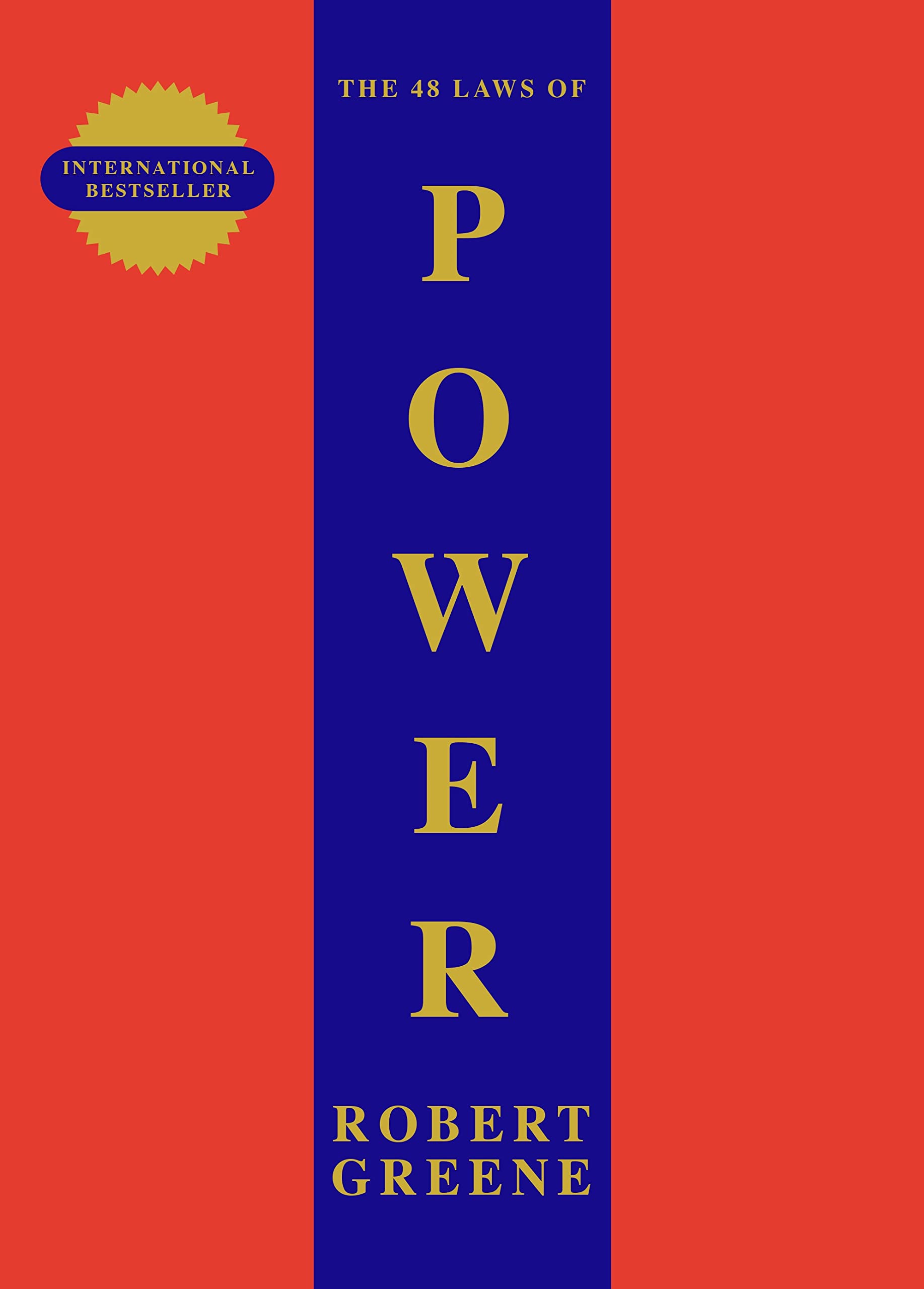
Goodreads Summary
Amoral, cunning, ruthless, and instructive, this multi-million-copy New York Times bestseller is the definitive manual for anyone interested in gaining, observing, or defending against ultimate control.
In the book that People magazine proclaimed “beguiling” and “fascinating,” Robert Greene and Joost Elffers distill three thousand years of the history of power into 48 essential laws, drawing from the philosophies of Machiavelli, Sun Tzu, and Carl von Clausewitz, as well as from the lives of figures ranging from Henry Kissinger to P.T. Barnum.
Some laws teach the need for prudence (“Law 1: Never Outshine the Master”), others teach the value of confidence (“Law 28: Enter Action with Boldness”), and many recommend absolute self-preservation (“Law 15: Crush Your Enemy Totally”). Every law, though, has one thing in common: an interest in total domination. In a bold and arresting two-color package, The 48 Laws of Power is ideal whether your aim is conquest, self-defense, or simply understanding the rules of the game.
A Summary of My Interpretation
The 48 Laws of Power is an insightful dive into the science of power that delivers everything it promises—perhaps a bit too well. Even an amateur historian will quickly notice that virtually every dictator followed and broke several of these laws, experiencing the consequences that followed.
The fact that this book presents positive “laws,” not normative “ideas,” is itself implicit proof that history tends to repeat itself. Or perhaps it’s that human nature has stayed consistent over the centuries, thereby reinforcing the credibility of these laws.
For those unfamiliar with Machiavelli’s teachings, this is a perfect, vivid introduction to playing the game of power by the principle that “the means justify the ends,” even if you’re usually bored by historical analysis. If you go on to read The Prince, which is referenced several times in the margins of The 48 Laws, you will notice how the laws reflect the political attitudes of the Italian diplomat. Although I personally do not subscribe to this approach to politics, it is useful for explaining and classifying what, in the academic realms of the social sciences and humanities, is present everywhere implicitly but stated nowhere explicitly.
A Warning to the Reader
What you will feel after finishing this masterpiece is either a sense of enlightenment, equivocally balanced by an unshakable paranoia (as Joseph Stalin did), that will haunt you so long as you live by the ideals of this book. Or you’ll appreciate the stories and cast aside the laws themselves, returning to daily life, choosing to remain ignorant of this distilled aggregation of ancient wisdom—a guide to survival and success for the average politician of the last five centuries.
I wouldn’t blame the latter. It’s not unreasonable to want to detach oneself from the cynical web of politics that hound our offices, neighborhoods, prisons, and schools across the world. But Greene succinctly explains why we must engage—at least to some extent—in the Preface:
“Today we face a peculiarly similar paradox to that of the courtier: Everything must appear civilized, decent, democratic and fair. But if we play by those rules too strictly, if we take them too literally, we are crushed by those around us who are not so foolish. As the great Renaissance diplomat and courtier Niccolò Machiavelli wrote, ‘Any man who tries to be good all the time is bound to come to ruin among the great number who are not good.’”
—Robert Greene, The 48 Laws of Power, Preface
Inferring that Greene suggests lying, cheating, and backstabbing at every opportunity is a misinterpretation of his real, more complex message. A message I personally believe was surprisingly articulated best by Jesus Christ himself:
“Behold, I send you forth as sheep in the midst of wolves: be ye therefore wise as serpents, and harmless as doves.”
—Matthew 10:16 (ESV)
After much introspection, I realized that the best use of The 48 Laws is as a shield—to defend against attacks and recognize the pitfalls and traps present in every organization. The reader does not have to become one of the several selfish manipulators presented in the book. Each has the freedom to choose how to utilize the knowledge of each law and apply it to their own environment—something frequently discussed at the book’s subreddit.
Conclusion
The 48 laws are, in essence, just an explanation of the obvious—and sometimes, the less than obvious (contrast the first law with the 26th and you’ll see what I mean). If treated as such, this book only benefits the reader who authoritatively sifts through its contents, leaving out the irrelevant (to their own circumstances) and perhaps morally questionable ideas that dominate the Machiavellian path.
However, if treated too seriously, the exact opposite will likely occur. That is why it has been banned in prisons and schools—lest it corrupts minds that otherwise would be free of the paranoia and ruthlessly tactical cynicism it plants and nurtures in the naïvely innocent or criminally dangerous.
Nevertheless, The 48 Laws of Power must be (carefully) read by all who play the game of life. The wisdom it contains—if used properly—can be of great use in the largely selfish world we live in.
★★★★☆ – 4/5
Leave a Reply