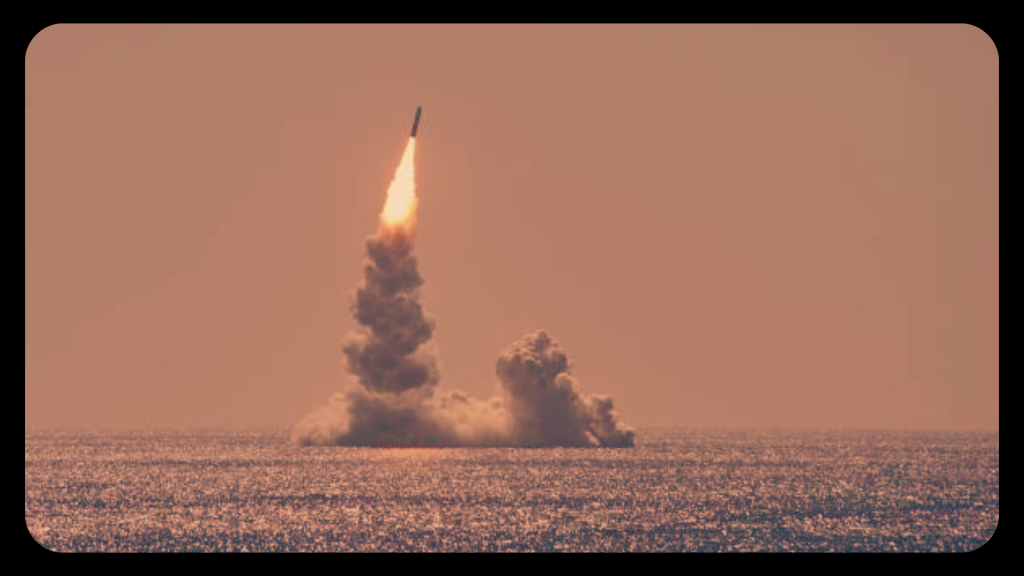

Image: US trident II Missile launch
This foundational concept in game theory has consistently manifested itself throughout the history of “cold” international conflicts—ever since nation-states could preserve, demonstrate, and accumulate their power by any means, even when such pursuits had no foreseeable end. Or more principally, wherever there is mutual paranoia about the outcome yet absolute certainty about the consequences of each individual choice, the prisoner’s dilemma vividly crystallizes into existence and lays out, with disturbing clarity, the ineluctable fate of its participants.
In simple terms, the concept can be reduced to the following narrative:
Two members of a criminal gang are arrested and imprisoned. Each prisoner is in solitary confinement with no means of speaking to or exchanging messages with the other. The police admit they don’t have enough evidence to convict the pair on the principal charge. They plan to sentence both to a year in prison on a lesser charge. Simultaneously, the police offer each prisoner a Faustian bargain. If he testifies against his partner, he will go free while the partner will get three years in prison on the main charge. Oh, yes, there is a catch: if both prisoners testify against each other, both will be sentenced to two years in jail. The prisoners are given a little time to think this over, but in no case may either learn what the other has decided until he has irrevocably made his decision. Each is informed that the other prisoner is being offered the very same deal. Each prisoner is concerned only with his own welfare—with minimizing his own prison sentence (Poundstone, 1992).
Its application in geopolitics is initially straightforward. Nation-states tend to make their own security decisions independent of external knowledge. Each technological development sanctioned, military drill conducted, and economic rebuff initiated between states is a step in the game where the ultimate consequence is war.
Mutually Assured Destruction
“The threat that leaves something to chance.” — Thomas Schelling, The Strategy of Conflict (1960).
What nuclear weaponry did was introduce irretractability into the game of war. Once Truman dropped the bombs on Japan in August 1945, both the USSR and the United States understood they had come upon a weapon so great in force that there was no turning back from its existence.
As the Cold War crystallized, the large, cumbersome bombs that had to be deployed from B-29s and detonated by qualified scientists evolved into an array of forms: hypersonic missiles, artillery shells, underwater torpedoes, and other iterations that formalized the nuclear triad. A decision to strike could now be executed with unprecedented speed, leaving no room for hesitation.
However, one factor still prevented the dilemma from fully manifesting itself during the Cold War—missile defense systems. If either side could assume it could strike without sustaining a significant counterblow, it would be more likely to do so. In other words, anti-nuclear defense shifted the focus from assuring complete destruction to insuring against complete destruction.
This is why, in May 1972, both Richard Nixon and Leonid Brezhnev signed the Anti-Ballistic Missile (ABM) Treaty, which deliberately forbade the proliferation of national missile defense systems. Each side was permitted only two, and later only one, ABM site—leaving virtually the rest of each state defenseless. Neither side could now defect without ensuring its own destruction.
The Stanislav Petrov Incident
There is perhaps no better example to demonstrate how rational decision-making under uncertainty became integral to the Cold War’s enduring stasis.
On the night of 26 September 1983, a Soviet early-warning satellite system reported the launch of five American intercontinental ballistic missiles. According to established procedure, Lieutenant Colonel Stanislav Petrov, the officer on duty, was expected to classify the alert as credible and transmit it to his superiors, who would then consider authorizing a retaliatory strike.
Petrov, however, judged the report implausible. As he later explained, “When people start a war, they don’t start it with only five missiles.” His reasoning was straightforward: a genuine American first strike would almost certainly involve hundreds of missiles to ensure the destruction of the Soviet arsenal. Concluding that the system was in error, he declined to escalate the alert. Subsequent investigation confirmed his assessment—the warning had been triggered by sunlight reflecting off high-altitude clouds.
Petrov faced two possible courses of action, each carrying absolute consequences:
- Report the launch and risk precipitating a nuclear exchange based on false data. This seemed inconceivable since five missiles would never guarantee strategic success.
- Suppress the alarm and risk leaving his country exposed to a genuine attack.
By relying on the logic underpinning the prisoner’s dilemma, Petrov chose the rational path of restraint. His decision arguably prevented global annihilation.
The Iterative Dilemma
The Cold War, of course, was not a single, static dilemma. It was a repeated one. The “nuclear dilemma” was tested in multiple instances—from the Korean War (1950), following the Soviet Union’s first nuclear test in 1949, to the Cuban Missile Crisis (1962). Even after the Cold War, nuclear-armed adversaries such as India and Pakistan have repeatedly brought the world to the brink—in 1999, 2001, 2019, and as recently as May 2025.
Since nations tend to learn from prior encounters, information from previous “games” inevitably influences the outcomes of subsequent ones. However, the number of times the game is played—and whether it is finite or indefinite—matters immensely.
According to Robert Axelrod in The Evolution of Cooperation (1984):
“If the game is played a known, finite number of times, the players likewise have no incentive to cooperate on the last move, nor on the next-to-last move since both can anticipate a defection by the other player.”
He further notes:
“For cooperation to prove stable, the future must have a sufficiently large shadow … the importance of the next encounter between the same two individuals must be great enough to make non-cooperation an unprofitable strategy.” (Axelrod, 1984)
In other words, when the future remains uncertain, rational leaders are more likely to mutually back down at every major crisis—regardless of the intensity of tensions. This does not mean that conventional warfare disappears; it only means that, so long as intelligent and historically conscious leaders hold the trigger, nuclear war remains indefinitely postponed.
References:
- Schelling, T. (1960) The Strategy of Conflict. Cambridge, MA: Harvard University Press.
- Poundstone, W. (1992) Prisoner’s Dilemma. New York: Doubleday.
- Axelrod, R. (1984) The Evolution of Cooperation. New York: Basic Books.