
Know thyself, know thy enemy. A thousand battles, a thousand victories.
Sun Tzu, The Art of war
Why you must read this guide
It is likely you have reached this guide in an attempt to fix your grades as you are struggling in some subjects, maybe you feel lost and confused, or perhaps anxious despite your grades that you don not know enough. Or may be that you are not smart enough to get A*’s in all your subjects. No matter what your situation is , I believe this guide will be of great use in quelling your fears, answering your doubts and transforming your grades while preparing you for the future.
Even if you do indeed feel confident about your grades, I would still recommend you take a moment to hear me out. For I have both scars and crowns on my marksheet, I know what one must do and what one must not do. I have with me a distillation of wisdom that most students do not know. I have been in the trenches, flown in he airplanes and talked with the generals, I know how to turn anyone into ‘academic warrior’. It surprisingly isn’t difficult, It will take a few months of work until you reach a level of autonomy, but it is certainly possible, whether you believe it or not. I received 3 A*, 3A’s and a B in my IGCSEs, if you follow my advice you wont get below an A.
I will show you how to know your IGCSEs in a way that many students do not, even after completing getting their grades and moving on to the next stage of their education. Once you know, you will no longer fear your subjects, you will command them.
Decompilation
Choosing your subjects
My method to attack any exam (it is not novel to me) is to Decompile and Destroy. The first phase is simply maximizing my knowledge of what and how I will be tested. The decompilation process for your IGCSE’s begins at choosing your subjects. If you have already done so, skip to the next section.
If you haven’t already, the below list gives you a general idea on what subjects you must prioritize not every school will have every subject available, if a school does not offer a subject, you can learn it from a private tutor, or in a few cases, even by yourself
| Career Path | University Degree | Recommended IGCSE Subjects |
|---|---|---|
| Medicine | Medicine, Dentistry, Biomedical Sciences | Biology, Chemistry, Physics, Mathematics, English, a Second Language (e.g., French), ICT or Computer Science |
| Engineering | Mechanical, Electrical, Civil, Aerospace Eng. | Mathematics, Physics, Chemistry, English, Computer Science, Design & Tech (DT), Additional Math (if available) |
| Law | Law | English, History, Literature, Math, a Second Language, Economics or Global Perspectives |
| Computer Science | Computer Science, AI, Software Eng. | Mathematics, Computer Science, Physics, English, Additional Math, ICT, a Second Language (for global mobility) |
| Economics/Finance | Economics, Business, Finance, PPE | Mathematics, Economics, Business Studies, English, Geography, History, ICT |
| Politics/International Relations | PPE, IR, Political Science | English, History, Geography, Global Perspectives, Second Language, Economics, Literature |
| Architecture | Architecture | Mathematics, Physics, Art & Design, Design & Technology, English, Geography, Computer Science |
| Psychology | Psychology, Cognitive Sciences | Biology, English, Mathematics, Global Perspectives, Literature, History, a Second Language |
| English & Literature | English, Journalism, Creative Writing | English Language, English Literature, History, Global Perspectives, a Second Language, Drama |
| Business & Management | Business Admin, MBA, Marketing | Business Studies, Economics, English, Mathematics, ICT, Global Perspectives, a Second Language |
| Art & Design | Fine Art, Animation, Design | Art & Design, English, Mathematics, Design & Tech, Computer Science, Global Perspectives, Literature |
| Environmental Science | Environmental Studies, Sustainability | Biology, Chemistry, Geography, English, Global Perspectives, Mathematics, a Second Language |
- For STEM (Science, Tech, Engineering, Math), always include Math, Physics, Chemistry/Biology depending on the subfield.
- If you want get into a field that is particulary math intensive (ie: Artifical Intelligence, Economics) and wish to gain admission into an above average university, I strongly advise that you take Additional math if you have the the time, motivation, discipline and passion for the subject to study twice the amount of math that you usually would in 2 years
- In your IGCSE’s you should pick all the sciences if you are not sure which ones you will need for university, then diversify in your A levels / IBDP
- For Humanities and Social Sciences, prioritize English, History, Global Perspectives, and Languages.
- This stream is incredibly fluid, with the exception of FLE, I myself am pursuing the social sciences stream and will stress that you must pick First Language English if you want to succeed here, even and average grade in FLE is several times better than an excellent grade in English Second Language.
Regardless of your stream, I highly recommend you take First language English (0500) and Extended Mathematics (0580) (not the core version, it a useless qualification due to its incredibly low difficulty). They both provide valuable opportunities and teach very useful skills that are often necessary to succeed in most fields.
A small bylaw that many miss
There is an extra bit of accreditation you receive if you take a group of subjects that are spread out across the streams. It is called the ICE certification. The following text is all from this page in Cambridge website, please go there if you are interested in attaining this award.
Cambridge ICE is a group award for Cambridge IGCSE, and is very popular in the USA and South America.It allows schools to offer a broad and balanced curriculum by recognising the achievements of learners who pass examinations in at least seven Cambridge IGCSE subjects from five different subject groups, including two different languages.
Cambridge ICE curriculum
The Cambridge IGCSE subjects are grouped into five curriculum areas:
- Group I: Languages
- Group II: Humanities and Social Sciences
- Group III: Sciences
- Group IV: Mathematics
- Group V: Professional and Creative
Learners must take two different languages from Group I, and one subject from each of Groups II, III, IV and V. The seventh subject can be taken from any of the five subject groups.
The subjects available are listed below. Please note that not all subjects are available in both the June and November series.
Environmental Management (0680) can count as either a Group II or a Group III subject, and Co-ordinated Sciences (Double Award) (0654) counts as two subjects. Global Perspectives (0457) can be taken as a qualifying subject in either Group II or Group V and from 2027, Statistics (0479) can count as either a Group IV or Group V subject. These subjects cannot be used to satisfy the criteria for both subject groups.
TL;DR – It demonstrates a student’s competence across a range of subjects and skills, making it a valuable credential for university admissions.
It looks like this when you get your results.

Analyzing and assessing your syllabi
Once all your subjects have been chosen. You may then begin collecting and reading every syllabus document for each of your subjects. You can get them here.
Warning !
Make sure you download the syllabi relevant to the year YOU are taking the exam, not the latest syllabi available. The year for which that syllabi is relevant is mentioned in its title
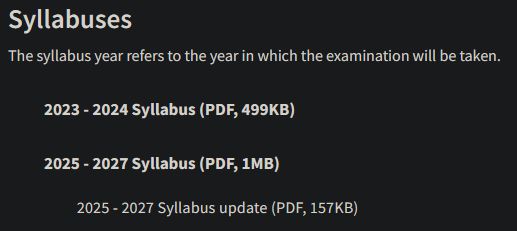
Its time to make a the file system that will house all your resources
It should have a mother folder appropriately named ‘IGCSE – main’ or any alternative, then subfolders for each of your subjects. Then place each syllabus into its respective subjects folder.
Textbooks & Revision guides
Depending on the subject, your textbooks are either your bibles (History, EVM), helpful guides (ICT, Math) or worst enemies (Computer Science (teachers have told me that it tends to overcomplicate things))
The textbooks you have already for school are probably those published by Cambridge themselves, I have heard they have been doing rounds when conducting their license renewal checks for schools, ensuring this is the standard practice (I can imagine why). But Cambridge books are not always the best, an knowing this is crucial. For example, the Hodder econmoics textbooks is much better organized and written than its cambridge equivalents.
Revision guides are likely the most underatted resource virtually nobody talks about, every hodder textbook’s revision guide is a distillation of the most important points, written by the authors themselves. This ,you will see, is often a suitable replacement for writing notes laboriously in class.
So what you must do is create a reddit post on r/igcse subreddit asking for the best textbooks for all of your subjects. For each response it is good to ask why they have chosen the said book.
[A solution to mitigate the expense of several textbooks:
It is common knowledge that all of us may not be able to afford several textbooks, but do possess internet connections and devices we can read them on. We are then forced to take on the occupation of Jack Sparrow himself. (IYKYK)The “Reading” section of this particular website will particularly helpful in allowing you to tread that path, but do note that I have always pressed that we must always strive to pay for the content we consume.
My personal Favorite textbooks for each of the subjects I took are the following, we call them by their publisher or Author’s names, google them to find their latest editions.
| Subject | Textbook author |
|---|---|
| Mathematics | David Rayner (Oxford University Press) |
| Economics | Paul Hoang (Hodder education) |
| History | Ben Walsh (2013 editon specifically) (Hodder) + The textbook recommended by your school. (It is good to read 2 textbooks for history) |
| EVM | Gary Skinner, Ken Crafer |
| French | Hodder |
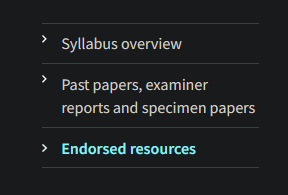
Find all of cambridges endorsed books for each subject in their respective page.
Learn from the masters
“A wise man should always follow the paths trodden by great men, and imitate those who have excelled. Even if one cannot match them completely, by imitating them one can at least attain some semblance of their greatness.”
— Machiavelli, The Prince, Chapter VI
The fastest and most efficient way to get an A* is unique for everybody, but the process for each subject is almost always.
Learn all the chapters -> Make notes -> Revise by utilizing knowledge gained-> doing topical past papers -> Doing 5-10 years worth of past papers -> Rinse and repeat until you consistently score above the A* threshold.
But the reality is that every student learns differently , tends to forget different things and falls into different vicious cycles that can kneecap their progress. Your job is to find the modus operandi that will match you. This may be what your teacher or parents tell you to do, but if you are not getting the results you wish from your study methods go back and setup and enquiry into everything you do for the subject. Even if you are unable to find the best method for yourself, I think the moderate difficulty of IGCSE does not demand much efficiency, unlike your A levels. My point is that for now a store bought axe will be enough to chop your overgrown trees, you don’t need to forge a custom one yet. The following instructions will help you obtain that axe quickly.
- Go on YouTube and search “How to get an A* in [subject]” for each of your subjects.
- Watch the first 5 videos with the most views.
- Write down what they all have advice they share common and what advice they don’t all talk about.
- Go on the r/igcse reddit and search for “A* IGCSE guide [subject]”
- Update you list with any new advice you get.
- Copy paste this list into and AI chatbot, and attach this prompt
Explain the purpose and effectiveness of each point of advice for the following, then organize it into a table with columns of "Adivce", "Purpose", "Effectiveness"
| Advice | Purpose | Effectiveness |
|---|---|---|
| Practice active recall | Improves memory retention | High |
I urge you to do this because you need to understand why you are following this process , only if you are convinced of it will you give it your best shot. If you are not, ask the AI your queries. But please be honest.
How to study
Make another table in a spreadsheet software that looks like this for each subject.
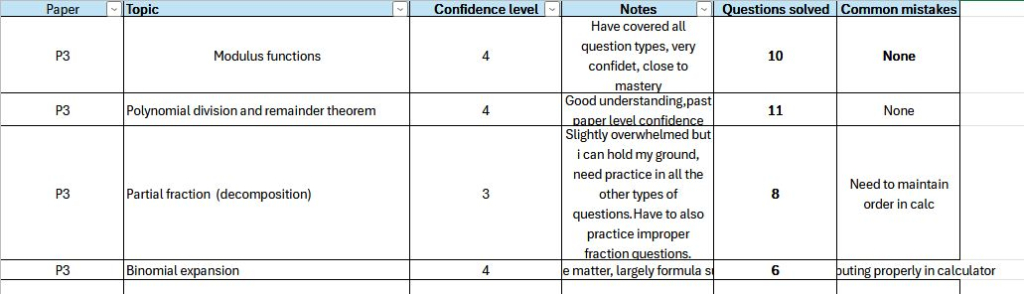
This will be your central progress tracker that will be of great use near exam time, be sure to honestly and frequently update this every 4 days. Feel free to adjust the fields based on the subject, for example for Economics you can substitute the ‘Questions solved’ with “Essay questions completed (8 marker + 6 marker)”. After you have made this the final in the decompilation process begins.
Creating your modus operandi
This is my personal modus operandi for mathematics I use in my A levels.
- Read brief notes to understand topic
- Watch a 2 hour video lecture to understand how to do the topics (eg : Zainematics)
- Rewatch, this time doing all the problems the teacher solved in the video
- Open the texbook and solve a few more problems.
- Check for common mistakes, ask an AI or someone on reddit/discord for doubts
- Open a topical pastpaper question and solve problems
- Step 5 again
- Repeat step 5 and 6 until all doubts clear and mastery over topic obtained
At any point in your process you may stop and update your progress in your spreadsheet.
The key here is formulating a process that efficiently increases your prowess in a subject.
A good modus operandi would
- Instill the topic at more than the expected level of depth required
- Be extremely time-efficient, producing meaningful results per hour of study.
- Leave no room for doubt
- Account for the forgetting curve.
This is beginning of the end of the “Decompilation” process, once you are about 35% of your way through your syllabi that will be real end as you would have received a grip over your subjects. And that’s when the real “Destruction” begins.
This is the end of the first of the 3 part series “Decompile and destroy your IGCSE’s”.