
Introduction
Agathocles the Sicilian became King of Syracuse not only from a private but from a low and abject position. This man, the son of a potter, through all the changes in his fortune always led an infamous life. Nevertheless, he accompanied his infamies with so much ability of mind and body that, having joined the militia, he rose through its ranks to be praetor of Syracuse. Being established in that position, and having resolved to make himself prince and to seize by violence, without obligation to others, that which had been conceded to him by consent, he came to an understanding for this purpose with Hamilcar, the Carthaginian, who was waging war in Sicily, and one morning assembled the people and the senate of Syracuse, as if he had to deliberate on matters of importance; and at a given signal the soldiers killed all the senators and the richest of the people; these dead, he seized and held the principality of that city without any civil commotion.
— Machiavelli, N. (1908) The Prince, trans. by W.K. Marriott. Chapter 8, paragraphs 2–3
In Chapter 8 of The Prince, Machiavelli recounts how Agathocles the Sicilian, born of humble stock and known for his infamies, seized Syracuse by massacre and held it without civil commotion. It’s an example of power exercised without scruple, without apology, and with no hesitation. This style of rulership—hardly a leadership quality in the traditional sense—manifests again and again in figures who rule not through consensus or tradition, but through the sheer volition of their own will.
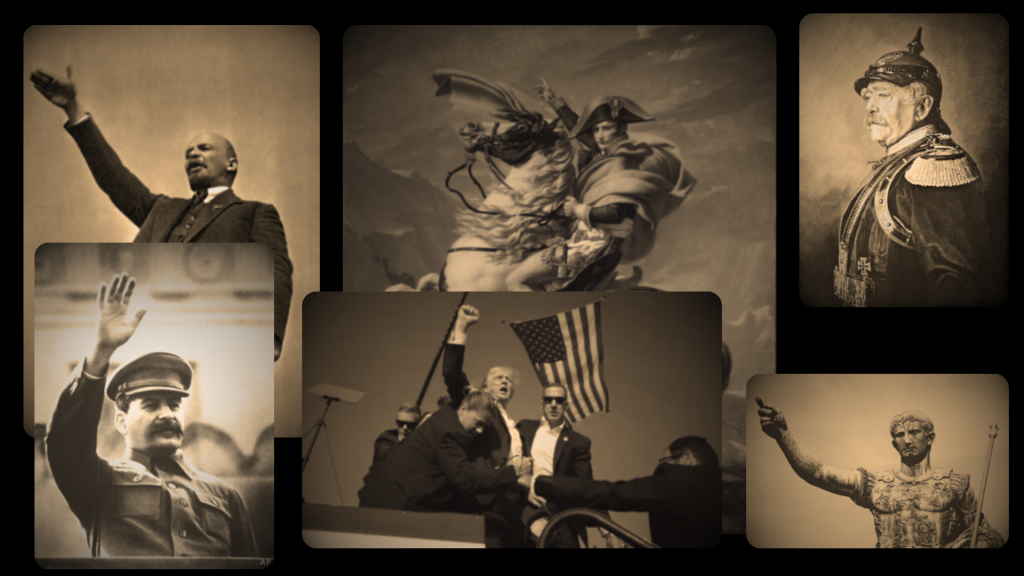
Napoleon, Lenin, Stalin, Trump—none, except Stalin, ever held absolute power as advertised, but all veered close. The relationship with power is more complex. What’s striking is that each of these men began their regimes with moves that looked reckless, aggressive, even suicidal in the short term. Yet, they all seemed to believe those risks would ultimately pay off—and that their nations would be better for it.
If all were alive today, it’s unlikely they’d agree on anything. But what they would agree on is this: a state not governed by themselves, but by a monarch or by institutions that enforce the shifting will of the people, is bound either to remain confused or to be dangerously misled from the top down. Take modern Saudi Arabia with its failed magnanimous architectural projects or the United States as radicalization makes remaining hard fast in fiscal policy oblivious to the evolution of the economy, for example, heavy protectionism is not always ideal in an economy, but if you are against it, you are a democrat. Ask any historian, and they’ll agree that these men were unwaveringly self-assured that their own visions for France, Russia, or America were the right and wise ones, and the only advisers and ministers who deserved a place at the policy table are the ones who share it.
The Archetype: Authoritarian Voluntarism
What defines this kind of ruler is the audacity to govern in a manner oblivious to political consequence. This mode of governance is a mutation of Realpolitik and Machiavellianism, but with a key difference: it’s grounded in faith—either in the righteousness of a personal vision or the ideology of a nation.
I could best communicate this with an allegory. Picture the soon-to-be ruler as the king’s loyal friend, given control of a province. He acts swiftly, decisively, shielded by royal backing. He moves things from A to B without political safety nets or rhetorical polish. He doesn’t soften blows to appease the people, acting hesitant in speculation of public outrage at controversial but necessary decisions. He simply utilizes his power to execute, end of story. Institutions that resist aren’t corrected—they’re removed. If he acts in the king’s best interest, he’s justified.
Now imagine the same character, but the king declares him his successor, and when he becomes king, the logic expands: his will is the state. And so he goes about enforcing his policy with ruthless efficiency and effectiveness. Now more empowered than ever before, and his friends who shared from his days as a lord his vision ascend alongside him to the council table.
When he has to, he does not negotiate, appease, or seek mutual consent with an ally. No, one simply communicates with action and very real threats, for he builds a reputation for not making empty ones. As a result, everything is accelerated to its real stage, with little to no gap for ambiguity. All the hands are played in very quick succession, and the world sees the results every week. Just recap the last 100 days of the Trump administration and tell me if any of this sounds familiar.
The thing is, critics tend to often misunderstand this type of ruler. They focus on his absurdity or abrasiveness. And do so on the reasonable assumption that politics in and between democracies is founded on compromise and institutional appeasement. This is like Chamberlain assessing the actions of an authoritarian, Hitler, by libertarian standards. They simply aren’t playing the same game. I think Harold Nicholson puts it best:
“Chamberlain and his adviser, Sir Horace Wilson, stepped into diplomacy with the bright faithfulness of two curates entering a pub for the first time; they did not observe the difference between a social gathering and a rough‑house; nor did they realise that the tough guys assembled did not speak or understand their language.”
The use wildcards, deploying reckless gambits only when convinced of the outcome however destructive will eventually serve their purpose (consider the recent bombings of Iran by the US Airforce, achieving peace at virtually the cost of a few bombs). That’s the brilliance of it. The following are a non-exhaustive list of politicians who have succeeded and failed as a result of this policy.
Portraits of Authoritarian Voluntarists
Julius Caesar (100–44 BCE)
Context of Rise:
Caesar rose through the Roman political and military ranks by leveraging his battlefield success in Gaul to build mass popularity and a loyal army. Rome was decaying under internal divisions, and Caesar recognized the opportunity to reorient the republic around his singular will.
Authoritarian Voluntarism:
In 49 BCE, Caesar crossed the Rubicon, illegally bringing his army into Rome and effectively declaring civil war. He bypassed the Senate, consolidated power, and declared himself dictator perpetuo (dictator for life). He governed unilaterally, redistributing land and altering institutions with minimal consultation.
Failure:
The Senate responded with assassination. Although Caesar’s reforms laid the groundwork for empire, his method of ignoring institutional balance and governing by fiat created the backlash that killed him. This proved that the republic was too fragile to resist a man like him, yet too proud to accept him.
Napoleon Bonaparte (1769–1821)
Context of Rise:
Emerging from the chaos of post-revolutionary France, Napoleon used military victories and public charisma to become First Consul. The state was weak, and he filled the vacuum with discipline and vision.
Authoritarian Voluntarism:
In 1804, he crowned himself Emperor in a theatrical rejection of both papal and aristocratic legitimacy. He centralized administration, imposed the Napoleonic Code, and launched continent-wide wars. He dismissed or replaced subordinates who failed or hesitated. He did not govern through institutions; he embodied them.
Failure:
His unchecked ambition led to overreach. The invasions of Russia and Spain and the collapse of his alliances stemmed from a lack of constraint. His rule was efficient but brittle. Without institutional support or succession planning, his empire collapsed the moment he lost military momentum.
Vladimir Lenin (1870–1924)
Context of Rise:
Lenin exploited the power vacuum after the Russian monarchy collapsed. The Provisional Government failed to address war and land issues. Lenin returned from exile and quickly rallied Bolshevik forces under a radical promise: peace, land, and bread.
Authoritarian Voluntarism:
After the Bolsheviks lost the Constituent Assembly elections, Lenin shut the assembly down and justified it by claiming the vote no longer represented the people. He ruled through Soviets, which became tools of the Party, which in turn became an extension of himself. Opposition was suppressed politically and violently.
“The vote… does not and cannot reflect the real will of the people.”
— Lenin, 1917
Failure:
His dream of global revolution never materialized. The USSR became isolated, and the violence of his governance triggered a brutal civil war. The dictatorship he created claimed to serve the proletariat, but eventually enslaved them to a state that exploited the Russian people for decades.
Joseph Stalin (1878–1953)
Context of Rise:
After Lenin’s death, Stalin outmaneuvered rivals in the Party. He gained control through bureaucracy and strategic violence, transforming loyalty into power.
Authoritarian Voluntarism:
Stalin eliminated Trotsky, Zinoviev, Kamenev, and others. He imposed Five-Year Plans, collectivization, and political terror through show trials and gulags. Institutions became tools of enforcement rather than governance.
Failure:
Although the USSR industrialized, it did so inefficiently. Quotas were inflated, output was falsified, and fear dominated innovation. The system valued spectacle over results and bred paranoia. Despite this, the Red Army’s raw production strength overpowered Nazi Germany at Seelow Heights in 1945, suggesting that even Stalin’s chaos produced brute-force results. But the cost was millions of lives and a traumatized nation.
Mustafa Kemal Atatürk (1881–1938)
Context of Rise:
After the fall of the Ottoman Empire, Atatürk led military and political resistance to foreign occupation. He unified the nationalist movement and became the uncontested architect of the modern Turkish state.
Authoritarian Voluntarism:
He dissolved the Sultanate, banned religious courts and garb, changed the Turkish script, and imposed secularism by decree. His cabinet and party were filled with loyalists, and dissent was suppressed. He did not negotiate reforms but forced them through.
Failure:
Though many reforms endured, the rigidity of his secular nationalism suppressed political pluralism. Turkish democracy became dependent on military guardianship, and coups occurred repeatedly in defense of his legacy. The strength of his rule made later dissent feel illegitimate.
Donald J. Trump (b. 1946)
Context of Rise:
Trump emerged as a political outsider capitalizing on public distrust in institutions and elite consensus. He framed himself as the voice of forgotten Americans and ran a campaign unbound by tradition or civility.
Authoritarian Voluntarism:
His presidency featured executive orders, tariff threats, and direct communication via Twitter. Cabinet officials were frequently fired or undermined. Loyalty to him outweighed protocol. He challenged political norms daily and treated institutional constraint as irrelevant.
Failure:
Protectionist policies achieved little. Trade relationships shifted only slightly. His disregard for institutional process culminated in a refusal to accept electoral loss, culminating in the January 6 Capitol riot. His voluntarism accelerated events but ultimately failed to secure durable gains.
Xi Jinping (b. 1953)
Context of Rise:
Xi inherited a China already shifting toward strongman politics. After decades of collective leadership, the Communist Party sought centralized discipline and ideological coherence.
Authoritarian Voluntarism:
Xi launched an anti-corruption campaign that served as a purge of rivals. In 2018, he removed presidential term limits, ending collective succession. Ideological conformity was reimposed across education, media, and civil society. Institutions remained, but primarily to echo Xi’s personal vision.
Failure:
China’s economic growth has slowed, and international relations have deteriorated. Centralized authority has stifled honest feedback and adaptive governance. Policy missteps such as the Zero-COVID strategy and real estate over-expansion have become harder to reverse under an inflexible command structure.
Adolf Hitler (1889–1945)
Context of Rise:
Hitler rose during a period of deep German humiliation following World War I and the Treaty of Versailles. The Weimar Republic was weak, plagued by economic crisis, political violence, and public disillusionment. Hitler leveraged nationalist anger and fear of communism to position himself as Germany’s savior. In 1933, after a series of electoral gains and political deals, he was appointed Chancellor. Soon after, he secured near-total power through the Reichstag Fire Decree and the Enabling Act.
Authoritarian Voluntarism:
Hitler swiftly dismantled Germany’s democratic institutions. Political parties were banned, opposition figures imprisoned or murdered, and the Nazi Party became the sole instrument of the state. He used propaganda, spectacle, and violence to forge unity under his personal rule. The SA and later the SS were used to eliminate rivals—including within his own ranks during the Night of the Long Knives. The Gestapo enforced ideological conformity. Hitler ignored institutional procedures entirely, often ruling through informal, chaotic channels of command where subordinates competed to interpret and fulfill his vague or verbal orders—a model historian Ian Kershaw called “working toward the Führer.”
Failure:
His unchecked dominance and isolation from dissent led to catastrophic decisions. The invasion of the Soviet Union and the declaration of war on the United States overextended Germany militarily. His refusal to retreat, adapt, or listen to generals doomed the war effort. Domestically, the cult of his personality enabled the Holocaust and other atrocities, which aside from genocide and the weakening of the German state by the eradication of its intelligent and productive Jewish community, contributed to its defeat int eh war by redirecting resources towards extermination rather than fighting. In the end, Hitler’s voluntarism didn’t merely collapse—it brought Germany to total ruin, left millions dead, and triggered the moral and physical devastation of an entire continent. As well as prospective peace in Europe for latter of the century.
Conclusion
From the above list we can see that a large segment of the pool of the most prominent leaders in history will fall under some variation of authoritarianism, whether they like the title or not. Perhaps the ideal leader is an authoritarian voluntarist whose foundation is the best interests of the people. But is this the best interests of the majority? And if so, does this mean that the wishes of the minority will never be reflected in its policies?
It is these kinds of questions that bring about these leaders, who genuinely think that they are doing the best for their nation. I continue to repeat this because it cannot be overstated. Niall Ferguson aptly explains why we will continue to see more authoritarian voluntarists in the future in Doom: The Politics of Catastrophe:
“The strongman reappears not because institutions fail, but because they are too slow, too hesitant, too fractured to act with the unity that crisis demands. The authoritarian doesn’t fill a vacuum; he seizes a pause.”
— Ferguson, N. (2021) Doom: The Politics of Catastrophe.